Key information
Main city: Kampala, Uganda.
Scope: City/town level
Lead organisations: Decentralised online network of Kampala citizens
Timeframe: 2023 – 2023
Themes: Neighbourhood and district economic development; Information and communication technology; Infrastructure; Metropolitan management; Public administration and governance; Transport and mobility
Social media campaign with little central financing.
Approaches used in initiative design and implementation:
- Citizen data collection: public encouraged to geo-locate potholes and give size estimates.
- Crowdsourced visual evidence: online imagery anchored public discourse, boosting transparency, accountability, media pickup and information exchange.
- Satire and humour: parody drew attention to deplorable conditions, making the issue shareable and hard to ignore.
- Short, time-bound awareness campaign: a defined campaign period generated significant initial uptake, built momentum and galvanised the public.
- Social media mobilisation: low-cost, low-risk online participation enabled broad reach among anyone with internet access.
Initiative description
Background and context
The initiative described in this case study took place in April 2023 against a backdrop of chronic underfunding of road maintenance in Kampala. Much of the city’s road network, laid in the 1960s and 1970s, has outlived its design life. Of the 2,100km of roads managed by the Kampala Capital City Authority (KCCA), only 650km (30%) are paved, with most already exceeding their intended lifespan; and of these managed roads, roughly 320km require full reconstruction (Parliament of Uganda, 2023; Parliament Watch, 2024).
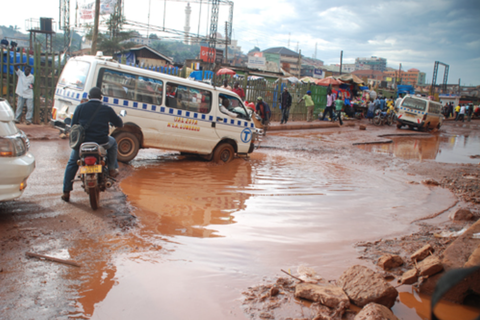
Rapid urbanisation, heavy traffic and periodic flooding have accelerated road surface deterioration, making potholes frequent and hazardous. City authorities acknowledged the scale of deterioration, estimating roughly 8,500 m² of active cavities across Kampala’s five divisions, with potholes clustered most visibly along flood-prone transit corridors and major drainage channels (BBC, 2023; New Vision, 2025). KCCA estimates the economic costs from poor road conditions to include higher vehicle repair bills (US$ 800 million annually), time lost to congestion (US$1.5 million daily) and losses to businesses and property (US$100-200 million annually) (Abaho, 2023).
Inadequate infrastructure maintenance funding is a systemic vulnerability for Kampala and other rapidly growing cities. Routine road operations and maintenance cannot keep pace with ageing assets, an expanding network, increasing vehicular traffic, population growth and intensifying climate pressures. And while national and development partner programmes have funded major upgrades to the city’s roads, junctions and drainage infrastructure, routine maintenance budgets have been more volatile, limiting road upkeep. This fragmented funding and responsibility, coupled with pressures to expand an ageing network, result in a recurring backlog of maintenance needs that compounds over time, leading to potholes and other hazards.
As the city’s surfaces deteriorated and travel times lengthened, public frustration mounted. In April 2023, these frustrations found expression online through the “Kampala Pothole Exhibition” (KPE), a citizen-led social media campaign using humour and imagery to crowdsource evidence of potholes. By engaging a wide section of civic society and harnessing humour online, KPE sought to coalesce public attention into demands for change and calls for accountability.
More broadly, the campaign shone a spotlight on the systemic roots of Kampala’s pothole problem – ageing infrastructure, limited maintenance funds and fragmented institutional responsibility.
Within Uganda’s political environment, repressive legislation constrains dissent and open protest is discouraged and often policed (CIVICUS, 2017; Cheeseman and Dodsworth, 2023). The KPE illustrates how activism can shift into informal and digital arenas where satire and social media lower the risks of voicing grievances and pressing for action (Agabo, 2024).
Summary of initiative
The Kampala Pothole Exhibition (KPE) was a short but effective citizen-led social media campaign to spotlight the state of roads in Uganda’s capital. It was started in mid-April 2023 by Jimmy Spire Ssentongo, a Ugandan academic, columnist, cartoonist and activist, to focus national attention on the chronic failure of city road maintenance (BBC, 2023). Framed satirically as an online “exhibition”, the campaign invited residents to post photos of city potholes on Twitter/X using the hashtag #kampalapotholeexhibition. The aim, in Dr Ssentongo’s words, was to make authorities “uncomfortable at their own incompetence” (BBC, 2023). By curating citizen evidence online, it staged a form of protest that avoided the risks associated with street demonstrations.
Designed to run for a week, the exhibition went viral within days, generating 13,000 tweets on its first day (Draku, 2023). Alongside straightforward documentation, such as geolocated photos with rough size estimates, participants shared satirical and edited images – such as people fishing, swimming or sailing in crater-like potholes – that travelled widely in mainstream media. In response, some officials inadvertently amplified the content by sharing humorous posts, while others attempted a counternarrative by highlighting well-maintained roads.
One day after the campaign started, the flood of images forced debate into parliament and official briefings when the Deputy Speaker demanded a statement on Kampala’s roads, explicitly citing the ongoing Kampala Pothole Exhibition. A few days later, a committee was formally directed to do spot-checks on KCCA roads and report back to parliament. Less than a week after the campaign launched, Ugandan President Yoweri Museveni directed the emergency release of UGX 6 billion (US$1.6 million) for pothole filling and requested that KCCA provide regular public updates.[1]
Citizens continued posting pictures of potholes, with the hashtag staying active for several weeks. Media outlets played a bridging role by reporting both popular images and the ensuing parliamentary debate, helping channel citizen concerns into more formal political arenas. This widened the campaign’s reach and made it harder for authorities to ignore. In the immediate aftermath, city communications on road patching intensified and larger capital programmes (junction upgrades, drainage and road projects) continued or accelerated on parallel tracks.[2] While there is little evidence these larger programmes were directly influenced by the hashtag, the campaign helped keep maintenance and road conditions at the centre of public and political attention (Abaho, 2023).
The campaign’s central organising device was the hashtag #kampalapotholeexhibition, around which participating residents self-mobilised. Its success relied on the efforts and influence of a loose network of citizens (as documenters and curators), as well as journalists (media uptake), government agencies such as the KCCA (as the principal delivery agency) and national parliament (scrutiny). Its impact underscores how citizens’ voices, amplified through digital networks, can elicit high-level political action and tangible change.
Deliberate use of humour lowered the risks of speaking out, drew diverse users into a shared narrative, and built sustained pressure on authorities. The campaign used social media as both amplifier and conduit to spread information, images and satire at speed and scale. It showed how a problem that affects a significant section of civic society for long enough can turn the banality of failure into material for collective expression – something even acknowledged in parliamentary speeches, where Deputy Speaker Thomas Tayebwa remarked that Kampala had “potholes of every design and size – deep, shallow, wide, narrow; some filled with water, others bone-dry” (BBC, 2023).
[1]The presidential directive drew from existing budget lines, rather than making new allocations.
[2] For example, in September 2024, the World Bank and Agence Française de Développement approved US$600 million for the Greater Kampala Metropolitan Area Urban Development Programme (infrastructure and waste management) (World Bank, 2024).
Target population, communities, constituents or "beneficiaries"
The initiative sought to benefit Kampala’s residents and road users – commuters, pedestrians, boda boda riders, minibus taxi passengers, freight operators and nearby businesses – an estimated 3.85 million people in the wider metropolitan area. Poor road conditions impose large costs on residents and businesses (see Background section above). By triggering immediate government response, the campaign provided some short-term relief through improved safety and reduced costs, as well as potential longer-term benefits through an increase in attention on the issue.
Beyond road repairs, KPE also contributed to reshaping approaches citizens can take to engage with authorities – showcasing a low-risk, alternative model of accountability that recognises crowdsourced citizen reporting via social media as legitimate input. The requirement for regular repair updates reflects a modest but notable behavioural shift, albeit a temporary one.
ACRC themes
The following ACRC domains are relevant (links to ACRC domain pages):
- Neighbourhood and district economic development (primary domain)
- Land and connectivity
This case study connects with the ACRC domains of neighbourhood and district economic development and land and connectivity.
At the neighbourhood scale, everyday infrastructure and mobility failures such as potholes and drainage gaps raise transaction costs for livelihoods, restrict access to markets and services and erode local productivity. The campaign’s call for routine maintenance and transparent reporting reflects an effort to stabilise the micro-infrastructure that underpins urban district economies.
The case illustrates the common challenge of urban growth without connective infrastructure (Goodfellow et al., 2024), with rapid urban expansion outpacing basic infrastructure provision. It also underscores ACRC’s emphasis on institutional politics: fragmented authority shapes not only what gets delivered but also when and where. In Kampala’s case, public finances are stretched between expanding the city’s infrastructure footprint and maintaining basic services that neighbourhood economies rely on.
The KPE also highlights the role of digital connectivity, with citizen-generated images and posts offering a low-risk, low-cost way to spotlight long-standing service failures.
The following ACRC crosscutting themes are also relevant (links to ACRC domain pages):
Finance
Infrastructure finance is central to understanding the condition of Kampala’s roads. Whilst a significant amount of money has been allocated for general infrastructure development, including the expansion of the road network, there is an acute shortage of funding for existing infrastructure maintenance.
Responsibility for the greater Kampala metropolitan area’s transport network is split, with national roads managed by the National Roads Department[1] in the Ministry of Works and Transport and city roads planned and managed by KCCA. The city of Kampala generates substantial own-source revenue but remains heavily reliant on central government transfers (Haas and Löffler, 2025) and KCCA’s recurrent funding for road maintenance was largely channelled through the Uganda Road Fund[2] (URF) and released via the cash-management cycles of the Ministry of Finance, Planning and Economic Development (MoFPED). This creates structural dependence: even when KCCA’s work plans and contracts are ready, the timing and size of MoFPED releases determine what gets done and when. This dependency allows central authorities to shape priorities, often favouring visible construction projects over preventive maintenance (Ggoobi et al., 2020), a financing imbalance highlighted by the KPE campaign, which sought to reposition maintenance as a legitimate public concern and challenge the compromise that routinely favours new construction over operations and maintenance.
[1] The National Roads Department replaced the defunct Uganda National Roads Authority (UNRA).
[2] The URF and UNRA have been dissolved, with their responsibilities transferred to the Ministry of Works and Transport.
Climate change
Kampala’s potholes are the combined result of poor upkeep and growing climate pressures. They particularly cluster in flood-prone corridors, where intense rainfall and inadequate drainage undermine the road base (New Vision, 2025). The increasing frequency and intensity of rainfall events are likely to further stress ageing infrastructure.
Long-term planning for both existing and future infrastructure must account for heavier and more unpredictable rainfall, expanding urban populations and the interaction between drainage, roads and neighbourhood vulnerabilities. Whilst the impacts of extreme climate are likely to be uneven, in general low-income and flood-prone neighbourhoods will experience higher mobility costs, safety risks and economic disruption (Leck et al., 2025).
In crowdsourcing citizen-generated data, the campaign highlighted neighbourhoods particularly at risk of flooding and intensifying climate pressures. More broadly, this points to the importance of targeted investment in neighbourhood-scale improvements such as drainage, road surfacing and routine upkeep, rather than reliance on irregular patching works.
What has been learnt?
Effectiveness/success
How does the initiative define success?
The campaign initiator’s initial objective was to highlight the issue of potholes across the city of Kampala. To this end, success was defined by generating enough traction and momentum to influence the rate at which urgently needed road maintenance was carried out by the KCCA (Spire Ssentongo, 2023). For citizen participants, this also meant being heard by city authorities and being able to exercise their democratic right to protest.
How does this understanding of success overlap with the ACRC’s conceptual framework and theory of change?
The Kampala Pothole Exhibition aligns with two of the four preconditions for urban reform that ACRC identifies in its conceptual framework and theory of change. These are (i) mobilised citizens pushing for change and (ii) formal and informal reform coalitions:
Mobilised citizens. The campaign turned long-standing unspoken frustrations into a visible, low-risk form of collective action. Where previous road condition advocacy campaigns had relied on physical protest gatherings, here a wider section of city residents were able to participate via social media.
Formal and informal reform coalitions. Starting as a citizen-led effort, KPE pulled in actors from across the mainstream media and local and national political spheres, culminating in a top-down presidential directive, among other influences. As such, the campaign assembled a loose, informal, hybrid and short-term coalition of netizens and media, the former of which voiced their concerns, amplified by the latter.
In a limited sense, the campaign also links to another of ACRC’s preconditions for reform, elite political commitment. Citizen voice sparked a loose and informal cross-actor coalition that secured political commitment – an essential step towards turning attention into action. The president’s directive of funding for pothole repairs demonstrates that citizen pressure can trigger action from the very top. However, it is important to note that lasting improvements require commitment to be embedded across agencies and within budgets; in this case, government response lacked a longer-term view of infrastructure maintenance.
How successful has the initiative been?
As outlined below, the campaign effectively amplified citizens’ voices, triggering swift political action and raising levels of public accountability. Compared to earlier efforts, it generated broader participation and forged a wider coalition, securing fast responses and high-level political buy-in. However, impact was largely short term, and Kampala’s need for structural reforms in financing, engineering design and maintenance planning remain unaddressed.
Significant short-term traction with widespread, low-risk participation
Public agency was central to KPE’s success and the social media exhibition format proved effective in lowering participation costs, allowing flexible participation through online posting. Simple rules, such as submitting a photo, location and rough pothole size, were designed to effectively emphasise the scale of the problem and give citizen participants a sense of ownership.
By the organiser’s measure, the campaign succeeded in converting widespread frustration into collective action. A non-academic analysis of 326 tweets estimated a reach of ~569,000 and ~96,000 engagements, with sentiment largely neutral to positive; evidence of broad mobilisation rather than fringe outrage (Citizen Voices Curated and Amplified, 2023). This aligns with the immediate aim to highlight road deterioration and compel authorities to act.
Launching the KPE near the rainy season made road damage highly visible and this timing tapped effectively into long-standing frustrations. Importantly, the approach was not completely new and KPE built on earlier satirical campaigns that also highlighted road maintenance failures, such as in 2010, when activists tried to establish 8 June as “National Pothole Day” (BBC, 2010). While these earlier attempts relied on physical presence and/or lacked a unifying activity, the KPE provided a clear focal point – a time-boxed online “exhibition” that crowdsourced humour and satire. This format lowered risk, expanded participation and enabled citizens to coalesce around a shared citywide narrative.
Improvements in road quality
Early effects were visible for road users: within a week of the campaign’s launch, the KCCA was pressured to address the issue and provide regular updates on its pothole repair programme. KCCA reports that 23,698 m² of potholes were filled under the Uganda Road Fund in the first half of FY2023/24 (KCCA, 2024). And while there is limited comparative KCCA data, making it difficult to directly attribute these improvements to the exhibition’s influence from those already in planning, there is widespread media consensus that the 2023 social media exhibition accelerated and intensified both public discourse and urgent government action on pothole repairs in Kampala.
In the 12 months following the KPE, several national and international media outlets credited a spike in political and administrative road maintenance action to the campaign’s viral spread and the popular indignation it inspired (see, for example, Draku, 2023; The Independent, 2023; Gjergji, 2024; Fallon, 2024). Most coverage mentions the president’s financial response, new roads being prioritised for repair and the effect of online activism in drawing attention to the issue. This indicates that commuters and businesses benefited from at least some relief.
Shifts in state attitudes
The most immediate effect of the campaign was political. In April 2023, the president ordered the release of UGX 6 billion for emergency repairs – widely attributed to the public pressure generated by the KPE. Although this directive drew from existing budget lines rather than new allocations, it provided short-term relief and demonstrated that citizen mobilisation could compel a high-level response. In April 2024, the Uganda Road Fund provided a further UGX 3 billion top-up, signalling continued scrutiny, even if the baseline remained well below earlier levels. The political impact of the KPE was also amplified by a tour of some of the most dilapidated roads in Kampala provided to the Senior Presidential Advisor for Special Operations (President Museveni’s son), General Muhoozi Kainerugaba, in May, 2023 (Sheena, 2023). He later undertook a follow-up visit to inspect the progress of repair works in November, 2023 (KCCA, 2023b). While systemic funding challenges persist and the reduction in road fatalities has been modest, the campaign’s significance lies in altering state behaviour: it compelled KCCA to patch roads more quickly, communicate more openly and treat citizen reporting as a legitimate driver of maintenance priorities.
Understanding limitations
Continued need for lasting solutions
While the campaign drew attention to the poor state of Kampala’s roads, pushing potholes onto the national agenda and triggered emergency repairs, it could not address structural needs, such as planning for higher traffic volumes, improved engineering standards, or resilience to extreme rainfall. Long-term resilience, which was beyond the scope of the campaign, requires integrated planning (roads, drainage, land use) to address systemic vulnerabilities that will worsen with climate change.
The deeper problem remains chronic underinvestment in maintenance. Despite patching drives and new reporting requirements, KCCA fell short of its target in 2024 – achieving only 595 km of road repairs against 1,800 km planned (Office of the Auditor General, 2024). At current funding, KCCA can only repair around 10 km of roads annually. While allocations for FY2022/23 stood at UGX 26.8 billion (US$7.2 million), the sharp fall to UGX 10 billion (US$2.7 million) in FY2023/24 signalled worsening fiscal constraints and undermined the authority’s ability to carry out routine upkeep.
In parallel to the maintenance backlog, much of Kampala’s road financing has been tied to multi-year donor loans. These schemes prioritise large-scale construction and rehabilitation, reinforcing a structural bias towards capital projects over recurrent upkeep. This financing pattern reflects the political economy of service delivery: authorities face pressures to expand the network for a growing city, but routine operations and maintenance receive little attention or political credit.
Participation limitations
The primary obstacle for online exhibitions and campaigns is that their reach is limited to online citizens with social media access, leaving segments of the population as non-participants. Only about 16% of Kampala’s adult population is active on social media (Republic of Uganda, 2024b).
Potential for scaling and replicating
KPE was online, open to anyone and low-risk for participants, all factors which made it well suited to a constrained civic space. Its success depended on pre-existing public dissatisfaction with roads, a daily and highly visible grievance that all the residents of Kampala could relate to.
Whilst humour powered the uptake of the KPE, other issues of public concern are unlikely to lend themselves to satire. Relatively less successful attempts at replication have targeted more sensitive and politicised issues (such as #UgandaHealthExhibition, #UgandaNGOExhibition, #UgandaLabourExhibition, #UgandaSecurityExhibition). In contrast, KPE dealt with a universal service-delivery failure: potholes were easy to document, satire made participation engaging and authorities found it harder to dismiss the evidence as partisan. These factors gave it a high degree of traction.
In the case of the KPE, the opportunity lay in taking advantage of long-standing frustrations by using humour and visual storytelling. Campaigns that address similar societal concerns can draw on KPE’s key elements: clear framing, accessible participation, and visible feedback – all of which can be adapted to other services and urban contexts.
Because the campaign ran primarily on Twitter/X, participation was naturally skewed towards younger citizens with higher levels of social media access. Kampala’s demographic profile, with youth making up a large share of the population (Mukwaya et al., 2025), made it particularly receptive to this kind of online mobilisation. In contexts with older or less digitally connected populations, uptake might be slower.
At the same time, and given the portion of Kampala’s adult population active on social media, experience from collective-action research suggests momentum can still build if a relatively small but vocal minority engages. The often-cited “3.5% rule” (Chenoweth, 2020) highlights how sustained mobilisation from a small critical mass can exert disproportionate influence, especially when the issue resonates widely and is amplified by media.
Lessons for similar initiatives:
- Set a general baseline of purpose and importance. Be clear what the campaign is for and why it matters. In the case of the KPE, the target was an obvious failing by civil authorities in maintaining public assets (roads). The campaign tapped into a problem that was already seriously affecting the public.
- Identify a fixed time-frame. Decide how long the campaign will run, to create urgency and focus. In the case of the KPE, the exhibition was set for one week. Importantly, organisers gave residents advance notice before the launch, which allowed anticipation to build around an issue that had long generated frustration. This alignment of timing and public demand proved critical to its uptake (Draku, 2023).
- Identify the outcomes and set simple guidelines. State what success looks like and how to participate. For the KPE, guidelines included geotagging photos and estimating pothole size; the intended outcome was to bring the matter to the relevant authorities’ attention (Agabo, 2024).
- Allow public discourse to flow. Enable organic exchange (memes and images) so dialogue continues and momentum builds (BBC, 2023).
Participating agencies
Further information
References
Agabo, S (2024). “Digital activism through humour and satire: An analysis of the use of TikTok and X for political accountability in Uganda”. MA dissertation. Karachi: The Aga Khan University.
Cheeseman, N and Dodsworth, S (2023). “Defending civic space: When are campaigns against repressive laws successful?” The Journal of Development Studies, 59(5): 619-639.
Chenoweth, E (2020). “Questions, answers, and some cautionary updates regarding the 3.5% rule”. Carr Center Discussion Papers 2020-005. Cambridge, MA: Carr Center for Human Rights Policy, Harvard Kennedy School.
Ggoobi, R, Lukwago, D and Bogere, G (2020). “public expenditure governance in the roads sector, Kampala”. ACODE Policy Research Paper Series No 100. Kampala: Advocates Coaliton for Development and Environment (ACODE).
KCCA (2023a). Kampala Capital City Authority – Road Safety Report 2023. Kampala: KCCA.
KCCA (2024). “Vote: 122 KCCA – Ministerial Policy Statement FY 2024/2025”. Kampala: Kampala Capital City Authority.
Office of the Auditor General. (2024). Report of the Auditor General on the Kampala Capital City Authority – Performance of Routine Manual and Mechanised Maintenance of City Roads for the Financial Year 2023/24. Kampala: Auditor General.
Parliament of Uganda (2023). Report of the Committee on Physical Infrastructure on the Status of Roads in Kampala Capital City. Kampala: Office of the Clerk to Parliament.
Acknowledgements
The generative AI tool, ChatGPT (OpenAI, 2025), was used as an assistive resource to support the preparation of this case study. Specifically, it was used to:
- Search for and summarise publicly available information relating to the Kampala Pothole Exhibition (KPE);
- Synthesise and organise key details from verified public documents and media reports, which were subsequently cross-referenced by the author; and
- Assist in tabulating financial information related to the KPE and associated road maintenance programmes.
All substantive analysis, interpretation and written content were produced by the author. The text was subsequently reviewed and edited by members of the African Cities Research Consortium (ACRC) team prior to publication.
Reference:OpenAI (2025) ChatGPT [Large language model]. Available at: https://chat.openai.com/ (Accessed: 17 October 2025).
Cite this case study as:
Desa, S (2025). “Digital activism, viral accountability and citizen pressure: the #KampalaPotholeExhibition". ACRC Urban Reform Database case study. Manchester: African Cities Research Consortium, The University of Manchester.