Key information
Main city: Accra, Ghana.
Scope: City/town level
Lead organisations: Ghana Ministry of Works and Housing ; Ministry of Sanitation and Water Resources ; Ministry of Local Government, Chieftaincy and Religious Affairs Decentralisation and Rural Development
Timeframe: 2019 – 2027
Themes: Informal settlements; Climate change; Informality; Infrastructure; Resilience and risk reduction; Waste management
Main funder agencies: World Bank International Development Association. Total budget: USD 350 million (initial USD 200 million loan in 2019 with an additional USD 150 million approved in 2023 to scale up interventions). Finance invested to date: The cumulative disbursement to date is USD 127.1 million, representing 36.3% of the total credit of USD 350 million (World Bank, 2025). This amount includes USD 65 million allocated to Covid-19 via the Contingent Emergency Response Component (CERC) (Ministry of Works and Housing, 2024). Finance committed and still to be invested: There remain about USD 72.88 million from the original tranche of USD 200 million that has not yet been utilised as of 2024 (Ministry of Works and Housing, 2024). The extra USD 150 million is committed but is essentially part of the pipeline: these funds are designated for upcoming works (storm drains, detention ponds, compensation, and so on). As of the last reporting date by the Ministry of Finance in May 2024, the funds were not disbursed.
Approaches used in initiative design and implementation:
- Adaptive financing and contingency mechanisms: reallocating funds during crises (for example, Covid-19) and securing additional financing to address cost overruns and project delays.
- Integrated infrastructure upgrading, combining flood mitigation, drainage construction, waste management and community-level service improvements.
- Multisectoral and multilevel governance: coordinating delivery and oversight across national ministries, metropolitan and municipal assemblies, private contractors and donor agencies.
- Participatory planning and community upgrading: engaging residents in stakeholder consultations to prioritise needs and co-produce community upgrading plans.
- Performance-based grants and capacity building: strengthening local government through financial incentives, technical assistance and training, to enhance institutional capacity.
- Politically informed and locally co-produced project design: politically calibrated at the national level to align with state priorities yet co-produced at the local level to secure community legitimacy and implementation feasibility.
Initiative description
Background and context
Accra is Ghana’s political and economic hub, contributing over a third of national GDP. The city, however, faces growing vulnerability to flooding, due to rapid urban expansion, weak planning enforcement and intensifying rainfall (Amoako and Frimpong Boamah, 2015; Asabere et al., 2020; Oteng-Ababio et al., 2024). A recent study found that over 70% of the city is flood prone, with hotspots like the Odaw River Basin experiencing repeated disasters (Atakorah et al., 2023). Between 1968 and 2018, floods killed more than 600 people, including 150 in the catastrophic June 2015 floods and fuel explosion (Atakorah et al., 2023; Dekongmen et al., 2021; Amoako and Inkoom, 2018; Asumadu-Sarkodie et al., 2017). Economically, the risks are substantial: assets valued at over USD 3 billion in the Greater Accra Region are exposed to flood damage (AMA, 2019; World Bank, 2019). Critically, informal settlements and low-income communities, often situated in the most high-risk areas, disproportionately bear the burden through the loss of homes, livelihoods and lives. The challenge is compounded by Accra’s complex political economy. Mayors and chief executives of local assemblies are appointed and aligned with the incumbent political party strategies for development, which are mostly centralised in nature, limiting their real authority over land use, infrastructure investment and regulatory enforcement (Acheampong, 2021). This weak planning enforcement, coupled with incentives for highly visible, short-term projects, consistently undermines commitment to necessary long-term flood resilience efforts.
To address these escalating challenges, the government of Ghana, with support from the World Bank, launched the Greater Accra Resilient and Integrated Development (GARID) Project in 2019. The initiative targets areas inhabited by more than 2.5 million residents, with its first and second phases concentrated in the Odaw River Basin, the city’s most flood-prone corridor. The Odaw Basin reflects the catastrophic convergence of low-lying topography and the high concentration of informal settlements in Accra. Communities here, including the densely populated Old Fadama and Nima, are highly exposed, often residing in vulnerable locations along the riverbanks or floodplains (Amoako and Frimpong Boamah, 2015). These informal structures, coupled with the systemic issue of improper solid waste disposal into the drainage system, transform the basin into an annual disaster zone, significantly increasing the risk of cascading flood events and loss of life for low-income urban residents (World Bank, 2023). GARID is designed to address this complex nexus of poverty, informality and environmental hazard with interventions such as drainage network improvements, river channel dredging, construction of flood retention ponds, solid waste management upgrades and participatory infrastructure improvements in these vulnerable neighbourhoods
Crucially, the project embodies a hybrid governance model, combining top-down policy coordination with bottom-up participation. Its design and implementation are informed by political, technical and community consultations that engage metropolitan and municipal assemblies (MMAs), traditional authorities, civil society organisations and local communities within the Odaw Basin. Through this multi-actor collaboration, GARID seeks to link infrastructure upgrading with community resilience, marking a significant step towards an integrated and inclusive approach to flood risk management in Accra.
Summary of initiative
The Greater Accra Resilient and Integrated Development (GARID) Project is Ghana’s largest urban resilience programme, designed to address chronic flooding, waste management and climate risks in the capital region. The project preparation, which started in 2016 with a diagnostics study after the June 2015 fire and flood in Accra, was approved in 2019 with a USD 200 million World Bank loan. The initial phase (Phase 1) covers a five-year period (2020-2025). With a further top-up of USD 150 million in 2023 for Phase 2, GARID targets over 2.5 million residents of low-income, flood-prone areas of the Odaw River Basin. Its goal is to protect more than 138,000 households from direct flood impacts, while strengthening the capacity of city authorities to manage urban risks (Ministry of Finance, 2024; World Bank, 2024a).
The initiative is led by the national Ministry of Works and Housing, Ministry of Sanitation and Water Resources and Ministry of Local Government, Chieftaincy and Religious Affairs, working with 17 local metropolitan and municipal assemblies (MMAs). Technical delivery is supported by the Ghana Hydrological Authority, Water Resources Commission (WRC), National Disaster Management Organisation (NADMO), Ghana Meteorological Authority (GMet), Lands Commission, Environmental Protection Authority (EPA), Land Use and Spatial Planning Authority (LUSPA) and a host of private contractors, with overall financial oversight from the Ministry of Finance.
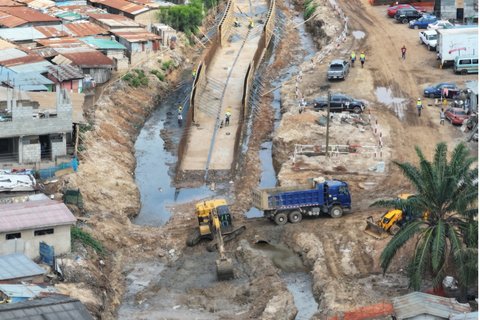
GARID is organised into five components. First, major flood risk mitigation works include dredging the Odaw River channel, constructing drains in hotspots such as Nima and Agbogbloshie and building upstream detention ponds. Second, solid waste management upgrades aim to improve services for nearly 500,000 residents, through expanded landfill capacity and equipment to prevent refuse from blocking drains. Third, participatory neighbourhood upgrading is providing access roads, streetlighting and water connections in informal and flood-vulnerable communities. Fourth, institutional strengthening supports MMAs with technical assistance, financial management, and grievance systems. A final contingent of emergency response component allows rapid fund reallocation during crises, first used during the Covid-19 pandemic.
The project employs a multilayered financing model, combining World Bank International Development Association (IDA) funding, government in-kind contributions (including monitoring officers, project staff and agencies delivering specific activities) and performance-based grants to local assemblies. This approach not only ensures project delivery but also incentivises local accountability and engagement. The extra USD 150 million committed for Phase 2 is essentially part of the project pipeline: these funds are designated for upcoming works (storm drains, detention ponds, compensation, and so on), together with an extension of the project closing date from 2025 to 2027. Beyond 2027, financing for a planned Phase 3 has not yet been secured.
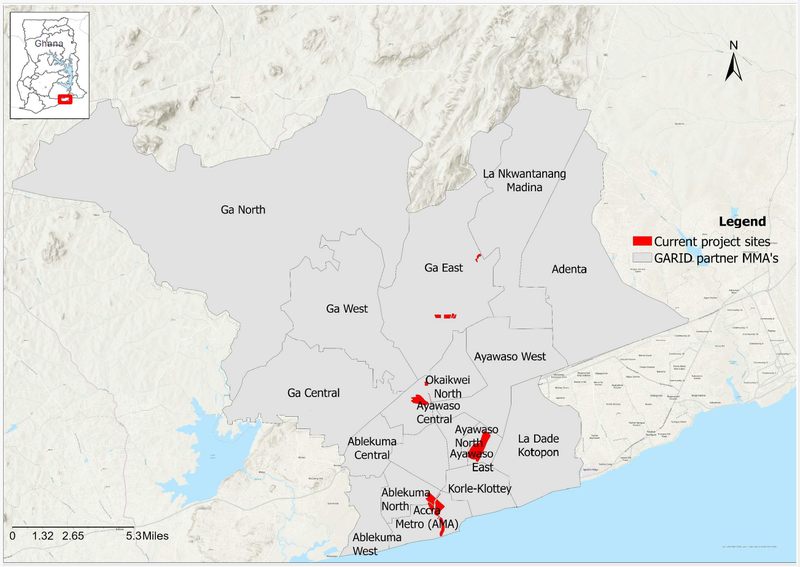
Progress has been uneven. By late 2024, around two-thirds of project financing for Phase 1 had been disbursed (Ministry of Works and Housing, 2024). Works were underway on new drains and roads in Agbogboshie, storm drains in Kaneshie and early warning systems across the basin. The project also released performance-based grants to MMAs, incentivising improved drainage and waste services and enhancing local accountability. At the same time, resettlement and compensation delays have fuelled mistrust in some communities,[1] while diversion of funds to the Covid-19 response slowed original plans (World Bank, 2024a). Mid-term reviews found no measurable reduction in flooding in target areas, and some residents reported frustration with prolonged disruption. Concerns also remain about centralised decision making and weak political commitment (Sheburah Essien et al., 2025; Wang, 2025).
Despite these challenges, GARID remains a landmark for Accra. Its integrated approach combines infrastructure, waste management and institutional reform at an unprecedented scale. It offers important lessons on the opportunities and difficulties of implementing large/big budget resilience projects in fast-urbanising African cities – particularly on the need for transparent governance, sustained political will and genuine community engagement.
[1] GARID’s relocation approach is not necessarily mass relocation to a single new site, but rather ensuring that affected persons are either compensated or assisted to move to safer grounds. In 2022, funds were approved to provide cash compensation for involuntary resettlement, covering the value of lost assets (structures, land holdings and economic assets) and any loss of livelihood. The World Bank estimated 2,874 project affected persons (PAPs) in total (Lynch, 2022).
Target population, communities, constituents or "beneficiaries"
GARID interventions focus on low-income, flood-prone communities within the Odaw River Basin, where more than 2.5 million residents are expected to benefit. Priority investments include new storm drains, detention ponds, flood early warning systems and improved solid waste infrastructure, such as transfer stations and engineered landfill. These works aim to directly reduce hazard exposure for over 138,000 people living in densely settled, high-risk neighbourhoods.
Targeting has prioritised informal communities with poor drainage and limited waste services, where households face recurrent flooding and lack durable housing. While central government agencies lead project design, local assemblies are responsible for mobilising residents and identifying needs, ensuring a measure of community input.
By mid-2024, progress was visible across several sites. Dredging of the Odaw River and construction of new drains was underway, while community-level upgrading had advanced significantly. The construction of roads, drains and water networks was more than 60% complete in Nima, 50% in Agbogbloshie and nearly half finished in Akweteyman. These investments are expected to improve safety, reduce losses from flooding and enhance access to basic services for some of Accra’s most vulnerable residents (World Bank, 2024b, 2025).
ACRC themes
The following ACRC domains are relevant (links to ACRC domain pages):
- Informal settlements (primary domain)
- Housing
- Safety and security
- Structural transformation
GARID connects to several ACRC domains, most notably informal settlements, structural transformation, safety and security, and housing. Its interventions concentrate on flood-prone, low-income communities in the Odaw River Basin, where inadequate drainage, poor waste management and insecure living conditions reinforce urban inequality. By upgrading drains, dredging channels and improving solid waste systems, GARID directly addresses vulnerabilities in informal settlements that have historically lacked investment.
At the same time, flood mitigation and neighbourhood upgrading safeguard livelihoods and small businesses, reducing disruption from recurrent disasters and supporting more resilient urban economic activity, a foundation for structural transformation. Safety is also a central concern, with detention ponds, storm drains and early warning systems reducing exposure to climate-related hazards. Although GARID does not build housing, it improves living conditions by reducing flooding and expanding access to basic services, thereby contributing to safer and healthier residential environments.
Overall, GARID demonstrates how cross-domain interventions can foster inclusive and resilient urban development, aligning closely with ACRC’s research agenda.
The following ACRC crosscutting themes are also relevant (links to ACRC domain pages):
Gender
Although GARID has no projects with a specific gender focus yet, many neighbourhood upgrading activities and infrastructure improvements, such as safer drainage systems, flood-protected access roads and water and sanitation facilities, help to reduce gender-specific risks and burdens and support women’s safety and resilience in daily urban life in Accra (see, for example, Anderson et al., 2024).
Climate change
Climate change adaptation is central to GARID’s design, which complements flood mitigation works, such as detention ponds, river dredging and upgraded stormwater networks, with early warning systems to prepare communities for extreme rainfall events. By embedding climate considerations into neighbourhood upgrading, the project design mitigates current and future flood risks, protects livelihoods and strengthens the resilience of vulnerable populations across Greater Accra.
What has been learnt?
Effectiveness/success
How does the initiative define success?
GARID defines success across its components through outcomes tied to both infrastructure delivery and institutional capacity, reflecting the priorities of funders, implementing agencies, local governments and communities.
In terms of climate-resilient drainage and flood mitigation, success is understood to be the construction of drains and dredging of the Odaw River, reducing flood exposure and protecting households, businesses and livelihoods in low-income communities. In solid waste management, success is measured by improved collection and disposal services for roughly 500,000 residents, enhanced landfill and transfer station capacity and better management of stormwater drains. Community engagement and transparency are also key indicators, fostering local ownership and responsible practices (World Bank, 2019, 2025).
Participatory upgrading success involves delivering essential infrastructure, such as roads, water connections, streetlighting, amongst others, while strengthening the capacities of the MMAs to plan, implement and maintain improvements. Finally, institutional support is successful when MMAs receive technical assistance, equipment and grants that enable effective project management and long-term resilience planning beyond GARID.
Overlap with the ACRC’s conceptual framework and theory of change
GARID is a good example of the application of the city of systems and political settlement concepts. It is reflected in the integrated nature of the programme and the organisational set-up of the project and aligns closely with ACRC’s framework, particularly the four preconditions for urban reform: mobilised citizens, formal and informal reform coalitions, agencies able to build short- and long-term state capacity, and political commitment from elites.
Mobilised citizens: Community participation is central to GARID’s approach. Residents of flood-prone areas engage in identifying infrastructure priorities and contributing to planning processes, and voluntary community committees support the maintenance of upgraded drains, roads and waste facilities. Local assemblies and community leaders facilitate participatory forums and initiatives, such as the “Sesa Wo Suban Clean Up Exercise”, strengthening collective action, enhancing accountability and ensuring that interventions reflect local priorities.
Formal and informal reform coalitions: GARID demonstrates the value of multi-stakeholder partnerships. Central and local government agencies, private contractors, civil society organisations and donors collaborate to deliver infrastructure, technical support and training. These coalitions bridge communities and institutional actors, providing access to expertise, financing and regulatory approvals, while helping to manage conflicts and streamline implementation.
Agencies building state capacity: GARID strengthens institutional capabilities at multiple levels. Local authorities gain skills in planning, procurement, revenue management and community engagement. Central agencies develop a better understanding of informal settlements’ needs and implement flexible mechanisms, such as performance-based grants, to support sustainable interventions. This dual focus enhances municipal capacity to respond effectively to urban challenges during and beyond the project’s lifecycle.
From the above, GARID demonstrates elite commitment, a critical pillar in the theories of change, by the combination of top-level political mandate and grassroots collaborative governance driving genuine, systemic urban reform. GARID was fundamentally built upon strong political buy-in, which manifested in its politically informed and co-produced design. This elite commitment was the necessary precondition that allowed the project's innovations, such as coordinated citizen mobilisation and the formation of multistakeholder coalitions, to translate into durable change.
How successful has GARID been?
Overall, GARID has made tangible progress in advancing urban resilience and transformation across flood-prone, low-income areas of Greater Accra. It has achieved partial but meaningful success, delivering infrastructure and institutional improvements, mobilising community engagement and laying the foundation for sustained resilience. While some components remain under construction, the initiative demonstrates significant progress against its objectives. GARID’s successes are measured through multiple perspectives, including funders, implementing agencies and beneficiary communities. The assessment here draws on the World Bank’s June 2025 report, local government assessments and observations of community engagement, infrastructure delivery and institutional strengthening.
Climate-resilient drainage and flood mitigation: Civil works contracts were awarded by December 2023, with design work underway for several drains. Contractor mobilisation took place in key communities, including Nima, Akweteyman and Agbogbloshie, as well as along drains such as Achimota and Nima. Progress has been gradual but visible. By May 2025, key drains were under construction: Abofu drain at 27% completion, Nima-Paloma at 7.3%, with Kaneshie drainage works underway. Dredging of the Odaw River, initiated in February 2024, represents a critical upstream intervention to improve water flow and reduce flood risks. Early benefits are apparent in urban markets, such as Abossey Okai and Agbogbloshie, where disruptions from flooding are expected to decline, supporting local livelihoods despite ongoing construction.
Solid waste management improvement: Municipal sanitation enforcement has strengthened, and behaviour-change initiatives are underway. Environmental health officers have received targeted training, while community-led programmes, such as the “Sesa Wo Suban Clean Up Exercise”, have been implemented across ten of 17 MMAs, fostering environmental responsibility and local ownership. In addition to this, 27 community committees have been organised and given solid waste collection equipment, and about 404,900m3 of solid waste from underserved low-income communities has been collected and disposed in sanitary landfills as of June 2025.
Participatory low-income community upgrading: Substantial progress is evident in Nima, where planned roads, drainage, water networks and streetlights are estimated at 68% completion. Aketeyman and Agbogbloshie are around 41% and 45%, respectively. These interventions enhance accessibility, reduce flood exposure and improve living standards for low-income residents, demonstrating the benefits of participatory planning and targeted infrastructure investment.
Institutional strengthening and community engagement: GARID has enhanced bottom-up participation, enabling residents to influence priorities, monitor interventions and support infrastructure maintenance. Local governments have benefited from grants, technical assistance and capacity-building initiatives that improve financial management, project planning and sanitation enforcement.
Provide a response to an eligible crisis or emergency: As of June 2025, GARID has adequately equipped 79 health facilities and tested 19,000 individuals per million of the population for Covid-19.
Additional financial achievements: The additional financing secured in 2023-2024 is for further critical interventions, including compensations, water detention ponds, engineered landfills, waste transfer stations, storm drains in Kaneshie and Nima-Paloma and flood early warning systems. These interventions not only mitigate immediate flood and sanitation risks but also strengthen municipal capacity and support long-term urban resilience.
Understanding limitations
While GARID has achieved notable progress, several challenges have constrained implementation and affected outcomes across targeted communities. The assessment below draws on World Bank reports, project monitoring and empirical observations of stakeholder engagement and infrastructure delivery.
Delays in infrastructure construction: Civil works have progressed more slowly than anticipated. Delays were driven by contractor mobilisation challenges, complex procurement procedures and coordination across 17 MMAs. These delays limited immediate reductions in flood risk for highly vulnerable areas, including major markets such as Agbogbloshie and Abossey Okai. The slow pace reflects broader governance and capacity constraints, including limited technical and operational autonomy at the local level within a highly centralised political settlement.
Compensation and resettlement challenges: Although GARID focuses on upgrading rather than formal resettlement, households affected by infrastructure works, including informal vendors and temporarily displaced residents, have experienced disruptions. Delays in compensation and complex grievance redress mechanisms occasionally eroded trust between communities and implementing authorities. This highlights the broader political challenge of reconciling national oversight with local responsiveness in contexts where informal livelihoods are politically sensitive and highly visible (Sheburah Essien et al., 2025; Wang, 2025).
Complex multistakeholder coordination: GARID involves multiple ministries, local assemblies, donor agencies and private contractors. Aligning priorities, coordinating responsibilities and managing overlapping mandates have often slowed approvals, implementation and reporting. Centralised decisionmaking sometimes limited local autonomy, constraining assemblies’ ability to respond quickly to community needs. This reflects structural features of Ghana’s political settlement, where national ministries retain dominant authority over resource allocation and project oversight, often at the expense of local flexibility.
Financial reallocations and budget pressures: The reallocation of USD 65 million from GARID’s original budget for Covid-19 relief, combined with additional financing to cover cost overruns, complicated planning and delayed certain interventions. Fluctuations in available funds occasionally constrained procurement, contractor mobilisation and expansion of flood mitigation infrastructure. These pressures illustrate the vulnerability of large donor-funded initiatives to shifting political priorities and external shocks.
Community expectations and engagement: Despite participatory planning initiatives, slow infrastructure delivery has sometimes led to resident dissatisfaction, with unmet expectations and temporary disruptions in services. Sustaining trust has required consistent communication, visible demonstration of progress and ongoing engagement through community forums and early wins, such as partial completion of drains, roads and waste facilities.
Environmental and logistical constraints: Construction in densely populated, flood-prone neighbourhoods has faced significant technical and logistical challenges, including limited space for machinery, seasonal rainfall and disruption to traffic and local markets. These factors have extended timelines and increased costs, highlighting the importance of adaptive planning, flexible scheduling and context-specific solutions.
GARID has sought to mitigate these limitations through phased construction approaches, strengthened coordination mechanisms, targeted capacity-building for MMAs and continuous community engagement (GARID, 2025). Lessons from the project underscore that technical interventions alone are insufficient in complex urban contexts; success depends on navigating political settlement dynamics, balancing centralised oversight with local agency and embedding mechanisms for transparent communication, grievance redress and adaptive management.
Potential for scaling and replicating
GARID holds substantial potential for scaling within Ghana and replication in other African cities confronting similar urban challenges, including flooding, rapid urbanisation, and informal settlements. The multi-phase design of the initiative offers a practical framework for replication, allowing other metropolitan areas to adapt its integrated approach to local contexts.
GARID has explicit plans for expansion. Phase 3, estimated at USD 400 million, aims to extend flood mitigation interventions to additional priority basins in the Greater Accra Region beyond the Odaw River Basin (Sheburah Essien et al., 2025: 5). A key challenge for this scaling effort is financing, as funding for Phase 3 has not yet been secured, underscoring the need for robust resource mobilisation strategies to ensure continuity and replication of the initiative’s successes.
GARID’s implementation offers several important lessons for agencies and practitioners designing similar urban resilience initiatives:
- Governance frameworks that combine centralised oversight with meaningful local autonomy. GARID revealed that dominance of national ministries in decisionmaking limited the operational flexibility of local MMAs. While centralised oversight ensured accountability, it slowed approvals and constrained adaptation to local needs. Future initiatives should adopt hybrid governance models that allow local authorities to make operational decisions while maintaining strategic oversight at the national level, improving responsiveness and efficiency.
- Sustain community engagement with institutional and resource support. Community initiatives such as the “Sesa Wo Suban Clean Up Exercise” demonstrated the power of citizen mobilisation to drive ownership and improved environmental practices. However, such efforts are not self-sustaining and require continuous activation, training and resources. Embedding participatory processes from the outset and providing ongoing support strengthens trust, maintains momentum and ensures long-term impact (Wang, 2025).
- Integrate multisectoral coordination from planning through implementation. GARID involved multiple ministries, MMAs, donor agencies and contractors, revealing the risks of siloed operations. Interministerial competition and fragmented planning slowed project implementation, particularly in areas like resettlement and infrastructure procurement. Integrating all stakeholders from the design stage ensures alignment, reduces conflicts and streamlines technical, financial and social interventions.
- Embed inclusive, transparent resettlement and compensation mechanisms. Even with an upgrading focus, affected households experienced disruptions during infrastructure works. Delays in compensation or lack of clear communication sometimes eroded trust. Future projects should implement transparent and inclusive resettlement and compensation strategies to foster community ownership, mitigate resistance and enhance participation in project activities.
- Build financial flexibility and contingency mechanisms to buffer shocks. GARID’s reallocation of USD 65 million for Covid-19 response and additional financing for cost overruns disrupted planning and delayed some interventions. Establishing flexible funding structures, such as performance-based grants or contingency reserves, can help maintain continuity, support timely procurement and protect critical activities from unexpected financial pressures.
- Plan for environmental and logistical constraints through adaptive and phased approaches. Construction in densely populated, flood-prone areas encountered space limitations, seasonal rainfall and disruption to market activities, affecting timelines and costs. Phased construction, adaptive scheduling and proactive mitigation strategies are essential to manage technical, environmental and logistical challenges in complex urban settings.
Participating agencies
Further information
Further resources
References
Amoako, C and Frimpong Boamah, E (2015). “The three-dimensional causes of flooding in Accra, Ghana”. International Journal of Urban Sustainable Development 7(1): 109-129.
Amoako, C and Inkoom, DKB (2018). “The production of flood vulnerability in Accra, Ghana: Re-thinking flooding and informal urbanisation”. Urban Studies 55(13): 2903-2922.
Asabere, SB, Acheampong, RA, Ashiagbor, G, Beckers, SC, Keck, M, Erasmi, S and Sauer, D (2020). “Urbanization, land use transformation and spatio-environmental impacts: Analyses of trends and implications in major metropolitan regions of Ghana”. Land Use policy 96, 104707.
Oteng-Ababio, M, Agergaard, J, Møller-Jensen, L and Andreasen, MH (2024). “Flood risk reduction and resilient city growth in sub-Saharan Africa: Searching for coherence in Accra’s urban planning”. Frontiers in Sustainable Cities 6: 1118896.
Acknowledgements
AI tool (Gemini by Google) was used during the preparation of this case study to support research organisation and improve grammar and clarity, specifically to suggest edits for conciseness and readability, and check for grammatical errors and sentence structure. All substantive content, analysis, interpretation of sources and factual claims were authored by Augustine Yaw Asuah and reviewed and edited by Kate Lines. All source materials were independently verified and all decisions regarding content inclusion, accuracy and academic voice were made by the author. The author takes full responsibility for the accuracy and integrity of all information presented in this case study.
Cite this case study as:
Asuah, AY (2025). “The Greater Accra Resilient and Integrated Development Project (GARID)”. ACRC Urban Reform Database case study. Manchester: African Cities Research Consortium, The University of Manchester.